




Moral Entropy

§ 02 ◦ Index
 § 02 ◦ Index
Moral Entropy — ME—002 — 012 entries — Headwords follow catalog sequence ◦ Phonetic transcriptions in IPA ◦ Etymological sources given where applicable ◦ cf. = confer (compare) ◦ syn. = synonyms
ME—TR.001

Threnody
/ˈθrɛn.ə.di/
1. A mournful song, hymn, or poem composed to commemorate and lament the dead; a funeral song.
2. Any expression that functions as a formal act of grief; lamentation elevated to artistic form.
syn. ◦ dirge ◦ elegy ◦ keen ◦ requiem ◦ epicedium
◦ ME—TR.001 / Catalog: Moral Entropy
ME—HA.002
Halation
/həˈleɪ.ʃən/
1. The spreading of light beyond its proper boundary in a photographic image; a blurred halo around highlights caused by internal reflections within the film emulsion.
2. Optics. A lens or sensor aberration in which bright sources bleed outward, creating an aura of misdirected luminance beyond the object.
cf. ◦ bloom ◦ chromatic aberration ◦ lens flare ◦ phosphene
◦ ME—HA.002 / Catalog: Moral Entropy
ME—PH.003

Phosphene
/ˈfɒs.fiːn/
1. A luminous impression — rings, spots, or waves of color — caused by excitation of the retina through means other than light: mechanical pressure, electrical stimulation, or certain compounds.
2. Any perception of light arising in the complete absence of external illumination; endogenous light.
cf. ◦ entoptic phenomenon ◦ halation ◦ scotoma ◦ subjective visual phenomena
◦ ME—PH.003 / Catalog: Moral Entropy
ME—RD.004
Raison d'être
/ˌreɪ.zɒ̃ ˈdɛtʁ/
1. The most important reason or purpose for someone's existence; the primary justification for being.
2. A defining purpose that provides meaning beyond survival or function; the why beneath the what.
cf. ◦ telos ◦ vocation ◦ calling ◦ existential foundation
◦ ME—RD.004 / Catalog: Moral Entropy
ME—WB.005
Wealthy Beyond Measure
—
Though I may not possess the material possessions the flawed human I am desires, I am wealthy beyond measure because of the gifts I have been given. My family.
◦ ME—WB.005 / Catalog: Moral Entropy
ME—CW.006

Cold Water
—
Plain speech. No further annotation.
◦ ME—CW.006 / Catalog: Moral Entropy
ME—AN.007

Anneal
/əˈniːl/
1. To heat metal or glass to a specific temperature and allow it to cool slowly, relieving internal stresses and increasing ductility. Cf. quenching (rapid cooling), which produces hardness but brittleness.
2. To toughen or strengthen through the disciplined application of heat and gradual release; to harden through the measured experience of trial.
cf. ◦ temper ◦ quench ◦ forge ◦ calcine
◦ ME—AN.007 / Catalog: Moral Entropy
ME—UU.008

Unforgiving, Unforgiven
/ˌʌn.fəˈɡɪv.ɪŋ/ ◦ /ˌʌn.fəˈɡɪv.ən/
Unforgiving. Making no allowance for error or human weakness; mercilessly demanding of precision or perfection.
Unforgiven. Not having received, been offered, or accepted forgiveness; bearing the full and unrelieved weight of transgression.
◦ ME—UU.008 / Catalog: Moral Entropy
ME—RF.009

Reaction Formation
/riˈæk.ʃən fɔːˈmeɪ.ʃən/
An unconscious defense mechanism by which the ego converts an anxiety-producing impulse into its direct opposite, expressing the inversion in behavior or affect rather than the original feeling.
cf. ◦ sublimation ◦ repression ◦ displacement ◦ rationalization ◦ projection
◦ ME—RF.009 / Catalog: Moral Entropy
ME—MA.010

Magnetar
/ˈmæɡ.nɪ.tɑː/
1. A neutron star distinguished by an extraordinarily powerful magnetic field — on the order of 10¹⁵ gauss, approximately 10¹³ times the magnetic field of Earth.
2. Song is dumb dumb heavy
cf. ◦ neutron star ◦ pulsar ◦ white dwarf ◦ soft gamma repeater
◦ ME—MA.010 / Catalog: Moral Entropy
ME—AI.011

Annihilationist
/əˌnaɪ.ɪˈleɪ.ʃə.nɪst/
One who believes the ultimate end of the wicked is extinction — not perpetuation in suffering, not universal restoration, but the cessation of being.
cf. ◦ conditional immortality ◦ eternal conscious torment
◦ ME—AI.011 / Catalog: Moral Entropy
ME—TJ.012

Tsujigiri
/tsuːdʒiˈɡɪri/
The feudal Japanese practice of testing a newly acquired sword blade on an unsuspecting passerby; a trial of a weapon's quality performed on the innocent.
cf. ◦ iaijutsu ◦ tameshigiri ◦ 辻 (crossroads)
◦ ME—TJ.012 / Catalog: Moral Entropy
§ 03 ◦ Artist

Tregg Frank — Seattle, WA ◦ Guitarist ◦ Songwriter ◦ Producer ◦ Self-titled is the second full-length catalog entry under the artist name Moral Entropy ◦ Written and recorded 2021–2026 ◦ All songs written, performed, and produced by Tregg Frank with additional guitars and samples on Magnetar by Daniel Heptig
On the record
This album is self-titled because it feels like it represents what I've always been aiming for with my music under the name Moral Entropy. Music that collides genres and sounds from many different, disparate influences, music that feels introspective and quiet, yet loud and brash.
Some of the songs on this album took 5 years to write. I believe the oldest is Cold Water. Its current form is very different from the original sketch I uploaded to my Soundcloud in 2021. The second half of that song was rewritten numerous times. It didn't take shape until near the end of compiling these songs.
Through the course of writing this album, I also wrote many songs that did not make the cut or did not match the feeling this album is trying to convey. Those songs may see the light of day, or they may sit on my hard drive forever.
Two of these songs are for my boys, one of them is for my wife and her family. I am grateful and blessed to have what I have in my life, and I want these sounds to be my legacy.
Credits
All songs written, performed, and produced by Tregg Frank. Additional guitars and samples on Magnetar by Daniel Heptig. Recorded in Denver, CO, Thornton, CO, and Seattle, WA.
Mixed and mastered in Ableton Live. Guitar tones are a mix of THALL, Archetype Gojira by Neural DSP, and II II II II. Drums are One Kit Wonder: The Downbeat by GGD.
Balaguer semi-custom 8 string woodman, ESP LTD EC-1000 Deluxe, Squier Jazzmaster Vintage Modified Baritone, and Squier Contemporary Active Jazz Bass V HH were used to record the stringed instruments.
8 String is tuned E A E A D G B E, kept in tune by Evertune.
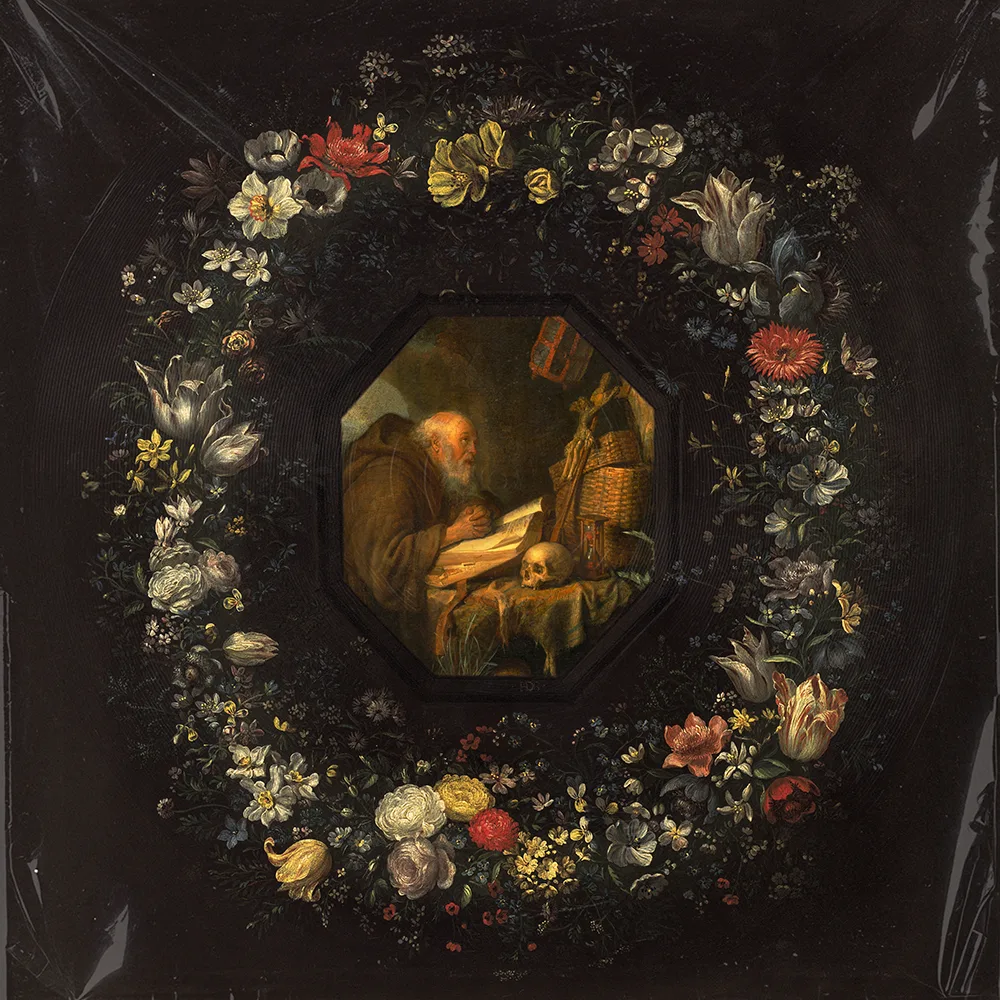
Album art by Tregg Frank, a photo collage of The Hermit by Gerrit Dou, c. 1670, and Garland of Flowers with Adoration of the Shepherds by Frans Francken the Younger and Master HDB, c. 1625/1630. Thankful for beautiful art that is public domain.
For Finn, Ellis, and Naomi.